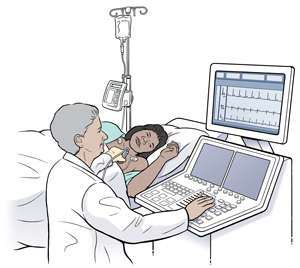
This type of echocardiogram (echo) uses dobutamine. This is a medicine that stimulates your heart a lot like exercise does. It's typically done to check how the heart responds to stress when you're unable to exercise on a treadmill or a bike. The medicine increases your heart rate and the squeezing function of your heart. Your healthcare provider gives you dobutamine through an IV (intravenous) line. They then take ultrasound pictures of your heart, using sound waves through a device placed on your chest wall (echocardiography). The pictures are taken before and after you get dobutamine. This lets your healthcare provider see if blood is flowing correctly through the heart and if your heart is pumping normally. The test is often done in a hospital or cardiac testing center.
Before your test
-
Tell your healthcare provider what medicines you take, and ask if you should take them before the test. This includes prescription and over-the-counter medicines. It also includes vitamins, herbs, and other supplements. You may need to not take certain medicines, such as beta-blockers, before the test.
-
Don’t smoke, drink alcohol, or have any caffeine for at least
12 hours before the test, or as directed by your healthcare provider. -
Follow any directions you're given for not eating or drinking before the test.
-
Wear a 2-piece outfit. You may need to undress from the waist up and put on a short hospital gown. Allow an extra hour for checking in and getting ready for the test.
During your test
-
Small, sticky pads (electrodes) are placed on your chest to record the electrical activity of your heart.
-
An IV (intravenous) line is placed in your arm.
-
A painless device (probe or transducer ) coated with cool gel is moved firmly over your chest. This device creates ultrasonic, inaudible sound waves that make images of your heart on a screen.
-
You'll get dobutamine slowly through the IV line, in small doses about every 3 minutes. It's normal to feel your heart pound for a few minutes while the medicine is being given.
-
Echo images are taken before the medicine is given, while you're getting the medicine, and after your pulse returns to normal. Your healthcare provider may give you a second medicine to slow your heartbeat to a normal level.
-
Your heart and blood pressure will be watched during and after the test.
After your test
When the test is over, you may return to your normal routine. Ask your healthcare provider about taking any medicine that you were told to skip before the test. Your provider will discuss your test results with you. The test results help your provider plan your treatment and any other tests you may need.
Report any symptoms
Be sure to tell your healthcare provider if you feel any of the following during the test:
-
Chest, arm, or jaw discomfort
-
A fast, strong, or irregular heartbeat (palpitations)
-
Flushed feeling
-
Shortness of breath
-
Upset stomach (nausea)
-
Headache
-
Numbness
-
Feeling lightheaded or like you might faint
Online Medical Reviewer: Ronald Karlin MD
Online Medical Reviewer: Stacey Wojcik MBA BSN RN
Online Medical Reviewer: Steven Kang MD
Date Last Reviewed: 04/01/2024
© 2000-2026 The StayWell Company, LLC. All rights reserved. This information is not intended as a substitute for professional medical care. Always follow your healthcare professional's instructions.
Need Help? We're Here for You
Our Member and Recipient Services Team is here to help you understand your benefits, find care, or resolve concerns.
800-510-9132
Call NC Quitline
Need support to quit smoking, vaping, or to quit other nicotine products? You can receive support including medicines free of charge:
800-784-8669
Schedule Transportation
Need transportation to a doctor's office, pharmacy, or other covered healthcare service? Contact us to arrange your ride.
800-510-9132
Provider Directory
Need to find a provider like a Primary Care Physician, Specialist, OB/GYN, or a Psychiatrist?
Provider DirectoryRelated Articles
Transesophageal Echocardiography (TEE)
Transesophageal echocardiography (TEE) is a test that allows your healthcare provider to record images of your heart from inside your esophagus, or food pipe.
Aortic Angiogram
An aortic angiogram is a test that takes pictures of the aorta. This is the main blood vessel that carries blood from your heart to the rest of your body. The test can show problems with your aorta, such as a blockage or an aneurysm (a balloon-like bulge in the wall of the aorta).
Checking Your Blood Pressure at Home
Home blood pressure monitoring can be a good way for you and your doctor to learn how your blood pressure changes during the day. Read on for the two different types of home devices, along with helpful tips for buying one.
Understanding coronary computed tomography angiography (CCTA)
CCTA is a type of imaging test that can detect blockages in the arteries of the heart.


