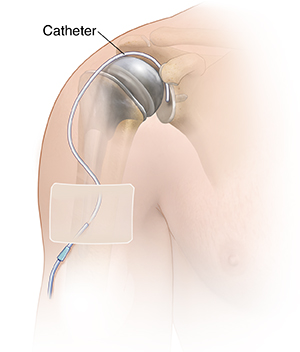
Infection may occur after a joint replacement. To treat it, antibiotics may be sent directly into the joint through a small, thin tube called a catheter. The catheter is placed during a surgical procedure. It remains in place for several weeks.
Why antibiotic treatment through a catheter for joint infection is done
Infection after a joint replacement may damage the new joint. This infection often needs several weeks of antibiotic treatment. To help antibiotics work best and most quickly, they are given directly into the joint. This is done through a soft tube called a catheter. The catheter is put into the joint and fixed in place. It remains in the joint until it's no longer needed.
How antibiotic treatment through a catheter for joint infection is done
-
The surgeon makes a small cut (incision) over the joint.
-
The surgeon puts the catheter through the incision into the joint. The catheter is often sewn into place.
-
The surgeon sews the skin closed around the catheter.
-
Fluids containing antibiotic medicines are sent through the catheter into the joint.
-
The catheter stays in place until the infection has been treated and the catheter is no longer needed. The surgeon then removes it during a second procedure.
Risks of antibiotic treatment through a catheter for joint infection
-
Infection
-
Bleeding
-
Blood clots
-
Catheter comes out of the joint and needs to be replaced
Author: Michels, Karen
Online Medical Reviewer: Raymond Turley Jr PA-C
Online Medical Reviewer: Stacey Wojcik MBA BSN RN
Online Medical Reviewer: Thomas N Joseph MD
Date Last Reviewed: 05/01/2022
© 2000-2026 The StayWell Company, LLC. All rights reserved. This information is not intended as a substitute for professional medical care. Always follow your healthcare professional's instructions.
Need Help? We're Here for You
Our Member Services team is here to help you understand your benefits, find care, or resolve concerns.
1-800-510-9132
Call NC Quitline
Need support to quit smoking, vaping, or to quit other nicotine products? You can receive support including medicines free of charge:
1-800-784-8669
Schedule Transportation
Need transportation to a doctor's office, pharmacy, or other covered healthcare service? Contact us to arrange your ride.
1-800-510-9132
Provider Directory
Need to find a provider like a Primary Care Physician, Specialist, OB/GYN, or a Psychiatrist?
Provider DirectoryRelated Articles
Facet Joint Injection
If a facet joint in your low back, middle back, or neck becomes inflamed, you may need a facet joint injection. This is medicine injected directly into the inflamed joint.
Surgery for Anterior Cruciate Ligament (ACL) Injury
The ACL (anterior cruciate ligament) is a band of tough, fibrous tissue that helps stabilize the knee. Injury to this ligament often happens when the knee is forced beyond its normal range of motion.
Hip Fracture Surgery: Types
The type of surgery you have often depends on where the hip is fractured. Read on to learn more.
Hip Fracture Repair
A hip fracture repair is a type of surgery to fix a broken (fractured) hip. Another name for this is internal fixation. Hip fracture repair uses screws, nails, or plates to help hold broken bones together so they can heal correctly. Learn more about surgery for a hip fracture.